Meet the Outer Solar System's Most Underrated Residents: 5 Dwarf Planets Worth Getting to Know
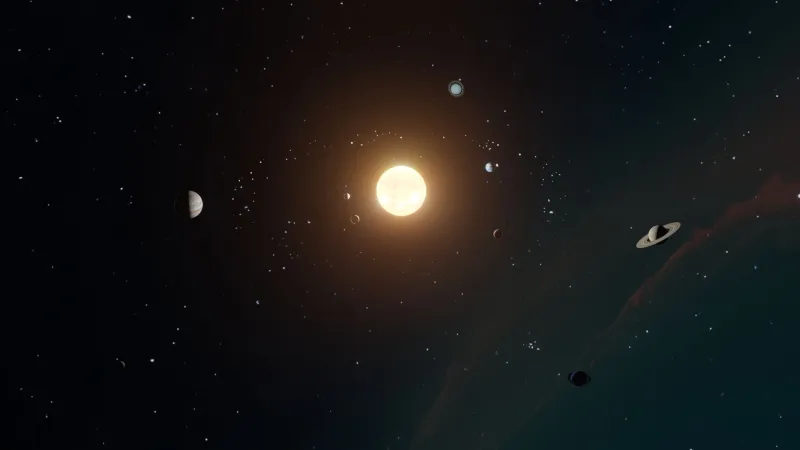
Pluto gets all the press. And look, we get it — Pluto is fascinating, its reclassification story is genuinely compelling, and those New Horizons images are legitimately beautiful. But Pluto isn't alone out there in the dark, frozen edges of our solar system. It's part of a sprawling community of small worlds — dwarf planets, plutinos, and trans-Neptunian objects — that are just as scientifically rich and a whole lot less famous.
Consider this your guide to the outer solar system's most overlooked residents. Each of these worlds challenges something we thought we knew about how planets form, how solar systems evolve, and what "interesting" even means when applied to a chunk of ice and rock 4 billion miles from the Sun.
1. Eris: The World That Started It All
Why it matters: Eris didn't just challenge the definition of a planet — it blew it up entirely.
Discovered in 2005 by astronomer Mike Brown and his team at Caltech, Eris sits in a region of space called the scattered disc, even farther out than the Kuiper Belt. At first glance, it looked bigger than Pluto. That single observation set off the chain of events that led to the IAU vote of 2006 and Pluto's reclassification — which is why Brown, somewhat infamously, nicknamed himself "the man who killed Pluto."
More precise measurements later revealed that Eris is actually slightly smaller than Pluto in diameter, but it's about 27 percent more massive, making it the most massive known dwarf planet in the solar system. It also has a small moon called Dysnomia.
What makes Eris especially intriguing is its orbit. It swings between about 38 and 97 astronomical units from the Sun — an enormous, elliptical path that takes roughly 559 Earth years to complete. At its farthest point, Eris is nearly twice as far from the Sun as Pluto ever gets. And yet, its surface appears to be one of the most reflective in the solar system, possibly due to a thin layer of frozen nitrogen or methane that refreshes itself as Eris slowly approaches the Sun.
2. Makemake: The Easter Bunny's Cosmic Cousin
Why it matters: Named after a Polynesian creation deity, Makemake has a nickname that's a little more whimsical — it was originally nicknamed "Easterbunny" by its discoverers because it was found just after Easter in 2005.
Makemake is one of the five officially recognized dwarf planets by the IAU and is the second-brightest object in the Kuiper Belt after Pluto. It's roughly two-thirds the size of Pluto, reddish-brown in color, and covered in frozen methane, ethane, and possibly nitrogen.
For years, scientists thought Makemake was a solitary world — until 2016, when Hubble Space Telescope observations revealed a small, dark moon orbiting it at close range. Nicknamed MK2, the moon is so dark it absorbs nearly all the light that hits it, making it almost invisible against the blackness of space. That's part of why it went undetected for so long.
MK2's existence is scientifically useful because it allows astronomers to calculate Makemake's mass with far greater precision than before. The more we can characterize these distant worlds, the better we understand the Kuiper Belt as a whole.
3. Haumea: The Solar System's Most Extreme Spinner
Why it matters: Haumea is one of the strangest-shaped large objects in the solar system — and it got that way for a genuinely wild reason.
Unlike every other dwarf planet, Haumea isn't round. It's shaped more like a rugby ball — or, if you prefer a more American reference, a football that got sat on. It's about the same mass as Pluto but stretched into an elongated ellipsoid roughly 1,200 miles long and 600 miles across at its widest.
The reason for this bizarre shape? Haumea spins faster than almost any other large object in the solar system. It completes a full rotation in just under four hours, and that rapid spin has flung its equatorial regions outward into that distinctive stretched shape.
Haumea also has two moons — Hi'iaka and Namaka — and in 2017, astronomers discovered something even more remarkable: a ring. Yes, a ring system, like Saturn's, but around a dwarf planet. It's the first ring system ever detected around a trans-Neptunian object, and it raises fascinating questions about how rings form around small, distant bodies.
4. Orcus: Pluto's Mirror World
Why it matters: Orcus occupies an orbit so similar to Pluto's that astronomers have nicknamed it "the anti-Pluto" — and the comparison goes deeper than orbital mechanics.
Orcus is a plutino, meaning it's locked in the same 2:3 orbital resonance with Neptune that Pluto is — it completes two orbits of the Sun for every three Neptune completes. But Orcus and Pluto are almost perfectly out of phase with each other, meaning when Pluto is closest to the Sun (perihelion), Orcus is farthest away, and vice versa.
Orcus is estimated to be roughly half Pluto's diameter, and like Pluto, it has a large moon relative to its own size — a companion called Vanth, which may be nearly half as large as Orcus itself. Some models suggest Vanth formed the same way Earth's Moon did: through a massive collision early in the solar system's history.
The surface of Orcus appears to be rich in water ice and possibly ammonia hydrates, which could suggest some form of past geological activity — perhaps even ancient cryovolcanism, where icy material erupts from the interior like a frozen version of volcanic activity.
5. Quaoar: The World With an Impossible Ring
Why it matters: Quaoar broke a rule that scientists thought was basically unbreakable — and nobody's entirely sure how.
Discovered in 2002, Quaoar is a mid-sized Kuiper Belt object about half the diameter of Pluto. For most of its post-discovery life, it was considered interesting but not particularly headline-grabbing. Then, in 2023, astronomers announced something that genuinely puzzled the planetary science community: Quaoar has a ring — and that ring exists in a place where it absolutely shouldn't.
Rings are generally expected to form close to a body, within a distance called the Roche limit, where tidal forces prevent ring particles from clumping together into a moon. Quaoar's ring sits well outside that limit — nearly twice as far out as theory predicted rings could persist. By all conventional understanding, those particles should have coalesced into a small moon long ago. They haven't.
The leading hypothesis involves the extreme cold of the outer solar system, which may keep ring particles rigid and elastic rather than sticky, allowing them to bounce off each other instead of clumping. But scientists are still working through the details, and Quaoar's ring remains one of the more genuinely puzzling recent discoveries in planetary science.
The Big Picture
If there's one takeaway from this tour of the outer solar system, it's that "small" doesn't mean "boring." Every one of these worlds — Eris, Makemake, Haumea, Orcus, Quaoar — has upended at least one assumption scientists held about how the solar system works. And we've barely scratched the surface.
Astronomers estimate there could be hundreds of dwarf planets in the Kuiper Belt and beyond, most of them still undetected and unnamed. Each one is a data point in the story of how our solar system formed, evolved, and arrived at the configuration we see today.
Pluto may have been the one that got us all asking questions. But the answers — strange, surprising, and often rule-breaking — are scattered across billions of miles of frozen darkness, waiting to be found.