Beyond the Edge: The Wild Hunt for Hidden Worlds in the Kuiper Belt
If you've ever stared out at a dark sky from somewhere far from city lights — maybe a camping trip in Colorado or a backyard in rural Texas — you've probably felt that particular brand of cosmic humility. All those stars, and we've barely scratched the surface. Now imagine that same feeling, but for astronomers who spend their careers hunting for entire worlds hiding just beyond Neptune. That's the energy driving one of the most exciting frontiers in planetary science right now.
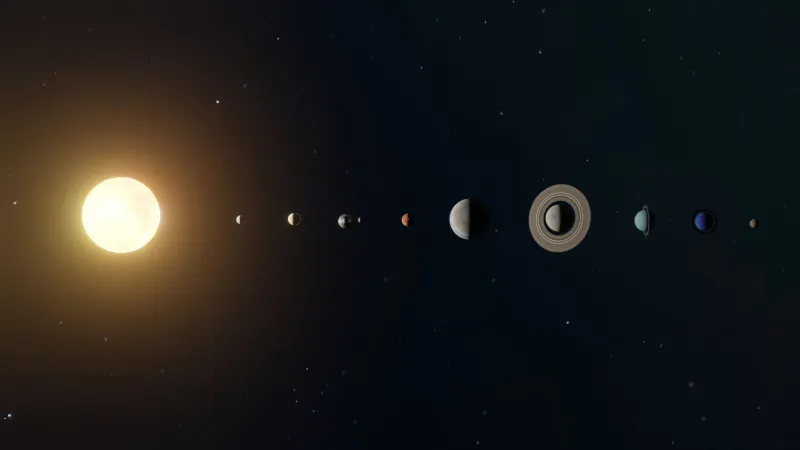
The Kuiper Belt — that sprawling, frozen doughnut of debris stretching from about 30 to 50 astronomical units from the Sun — is not the empty wasteland it was once assumed to be. It's a crowded, chaotic archive of the solar system's earliest history, and scientists believe it's still keeping serious secrets.
What Even Is the Kuiper Belt?
Think of the Kuiper Belt as the solar system's attic. It's packed with icy, rocky objects left over from the formation of the planets roughly 4.5 billion years ago. Pluto lives there. So do Eris, Makemake, and Haumea — all officially classified as dwarf planets. Hundreds of thousands of smaller Kuiper Belt Objects (KBOs) have already been catalogued, and estimates suggest there could be millions more we haven't spotted yet.
But here's the thing: the Kuiper Belt isn't just a cosmic junk drawer. The objects out there carry chemical and structural fingerprints from the solar system's birth. Finding new ones isn't just exciting — it's scientifically invaluable. Every discovery is a little time capsule.
The Gravitational Breadcrumbs That Started Everything
So why are astronomers so convinced something big is still out there waiting to be found? A lot of it comes down to a puzzle that's been nagging at the planetary science community for years.
Back in 2016, Caltech astronomers Mike Brown and Konstantin Batygin published a paper that sent shockwaves through the field. They noticed that a cluster of distant KBOs were orbiting in weirdly similar patterns — tilted and elongated in ways that seemed statistically impossible by chance. Their explanation? A large, unseen planet — sometimes called Planet Nine — was gravitationally herding these objects into alignment.
The math was compelling. The controversy was immediate. Some researchers pushed back hard, arguing the clustering might be a result of observational bias — basically, we only looked in certain parts of the sky, so of course things look clustered there. But the debate itself lit a fire under the whole field. Whether or not Planet Nine exists, everyone agreed on one thing: we needed to look harder and look smarter.
The Tools Changing the Game
That's exactly what's happening now. The Vera C. Rubin Observatory in Chile — named after the pioneering American astronomer who gave us the strongest evidence for dark matter — is poised to revolutionize this search. When it reaches full operational capacity, Rubin's Legacy Survey of Space and Time (LSST) will photograph the entire visible sky every few nights using a camera with 3.2 billion pixels. To put that in perspective, you'd need roughly 1,500 high-definition television screens to display a single one of its images.
For Kuiper Belt hunting, this is a game changer. Many KBOs are only detectable because they move — slowly drifting against the fixed backdrop of stars over days or weeks. Rubin's repeated sky coverage makes it possible to track that motion with unprecedented sensitivity. Scientists estimate the survey could discover tens of thousands of new KBOs within its first few years of operation.
Meanwhile, the James Webb Space Telescope has been quietly contributing too. While Webb is primarily celebrated for peering at distant galaxies and exoplanet atmospheres, its infrared sensitivity makes it uniquely capable of characterizing the surfaces and compositions of already-known KBOs in ways we've never managed before.
What Would a Major Discovery Actually Look Like?
Here's where things get genuinely thrilling. Not all potential discoveries are created equal.
Finding a new mid-sized KBO — something comparable to Pluto's moon Charon, say — would be scientifically interesting but wouldn't exactly break the internet. What would break the internet is finding something truly massive: a Mars-sized body, or larger, lurking in the deep outer solar system.
If Planet Nine exists and is eventually confirmed — through direct imaging or accumulated gravitational evidence — it would be the most significant planetary discovery since Neptune in 1846. It would force a wholesale rethinking of how the solar system formed and evolved. It might even reopen the messy, wonderful debate about what counts as a planet in the first place. (Yes, that debate again. We know. We love it too.)
Even a confirmed large dwarf planet — something bigger than Eris, which is already comparable in size to Pluto — would be a major deal. It would add to the growing evidence that the outer solar system is far more populated and dynamic than our old textbook diagrams ever suggested.
The Stakes Beyond the Science
There's a cultural dimension to this search that's worth pausing on. For a generation of Americans who grew up learning that our solar system had nine planets — and then had that rug yanked out from under them when Pluto got reclassified in 2006 — the idea of finding something new and significant out there carries real emotional weight.
Pluto's story taught us that the solar system isn't a fixed, finished thing. It's a place we're still actively discovering and redefining. The Kuiper Belt is living proof of that. Every time a new object is confirmed out there, it's a reminder that our cosmic neighborhood is stranger, richer, and more surprising than we imagined.
And if something truly unexpected turns up — a world that doesn't fit our existing categories, that demands new vocabulary and new frameworks — well, that's exactly the kind of discovery that makes planetary science feel less like a textbook subject and more like an ongoing adventure.
The Search Is the Point
Astronomers won't find the next big thing overnight. The Kuiper Belt is enormous, the objects are faint, and the sky is very, very large. But the tools are better than they've ever been, the scientific motivation is urgent, and the hints are tantalizing enough that nobody's looking away.
Somewhere beyond Neptune, past the orbit of Pluto, past the scattered disk and the classical belt, something might be waiting. It's been waiting for billions of years. And the people hunting for it are getting closer every single night.
That's the kind of search worth following.