Ripple Effect: How Pluto's Demotion Scrambled the Science of Finding Planets Beyond Our Sun
When the International Astronomical Union voted to reclassify Pluto in August 2006, most of the headlines focused on what we were losing — that familiar ninth planet, the underdog of the solar system, the one kids always rooted for. But quietly, in university offices and telescope control rooms around the world, a different kind of panic was setting in. Astronomers who spent their careers hunting for planets around other stars had a brand new problem on their hands.
If the definition of "planet" had just changed for our own backyard, what did that mean for every world they'd already catalogued — and every one they were about to discover?
The Definition That Broke Everything
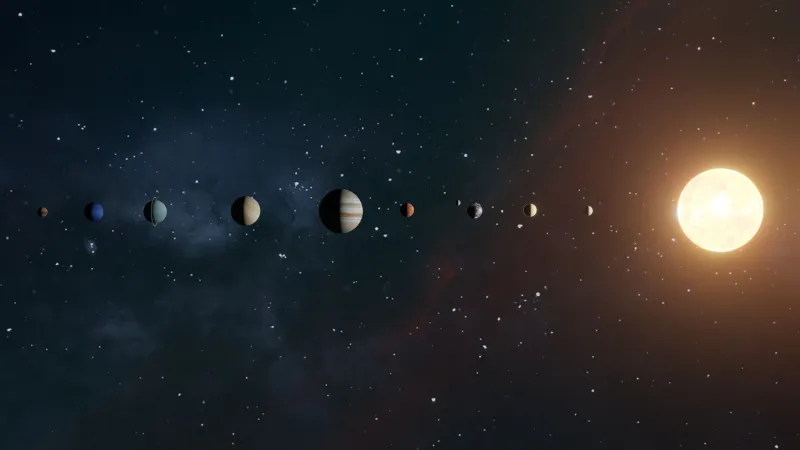
The IAU's 2006 ruling established three criteria a body must meet to qualify as a planet: it orbits the sun, it has enough mass to achieve a roughly spherical shape, and — the sticking point — it has "cleared the neighborhood" around its orbit. Pluto failed that last test. Its orbit overlaps with countless other Kuiper Belt objects, so out it went.
Simple enough in theory. Catastrophically complicated in practice — especially for exoplanet researchers.
The thing is, the IAU definition was written specifically for objects in our solar system. It literally says "orbits the sun." Not a star. The sun. Which means, technically speaking, every single exoplanet ever discovered exists in a definitional gray zone. Every hot Jupiter, every rocky super-Earth, every distant world orbiting a red dwarf — none of them are "planets" by the official rulebook.
Most astronomers just quietly ignored this and kept going. But the underlying tension never really went away.
Clearing the Neighborhood — From 40 Light-Years Away
Here's where things get genuinely tricky. One of the core reasons Pluto got bumped was that it hadn't gravitationally dominated its orbital zone. But imagine trying to apply that standard to an exoplanet.
When astronomers detect a world around another star, they're typically working with limited data — a dip in starlight from a transit, or a wobble in the star's motion from radial velocity measurements. They can often figure out a planet's size and mass. What they almost never have is a detailed census of every other object sharing that planet's orbital neighborhood.
So the "cleared the neighborhood" criterion — already the most contested part of Pluto's reclassification — becomes essentially unapplicable at interstellar distances. Researchers have had to develop their own working definitions, and those definitions don't always match each other.
Some teams classify anything above a certain mass threshold as a planet. Others draw the line based on formation history, distinguishing between objects that formed like planets and those that formed more like failed stars. The result is a field where the word "planet" gets used in subtly different ways depending on who's writing the paper.
The Pluto Hangover in Exoplanet Research
Dr. Sara Seager at MIT, one of the most prominent exoplanet researchers in the country, has been vocal about the limitations of rigid classification systems. The discovery of so-called "super-Earths" — worlds larger than our planet but smaller than Neptune — threw another wrench into the works. We don't have anything like them in our solar system, which means our existing categories were never built to accommodate them.
Then there are "rogue planets" — objects of planetary mass that drift through space untethered to any star. They don't orbit anything. By the IAU's definition, they're not planets at all. But calling them something else feels just as awkward.
Pluto's demotion didn't cause these headaches, but it did force the conversation into the open. Before 2006, the definition of "planet" felt settled, almost boring. After 2006, it became one of the most contested concepts in astronomy — and exoplanet science inherited all of that baggage.
A Field Forced to Grow Up
In some ways, the chaos has been productive. The scramble to define what a planet actually is pushed astronomers to think more carefully about what properties genuinely matter for understanding planetary systems. Is it size? Composition? Formation process? Orbital dynamics? The answer probably isn't any single factor.
The NASA Exoplanet Archive, which catalogs thousands of confirmed worlds, uses a working definition based on mass — roughly, anything below 13 Jupiter masses that orbits a star. It's pragmatic and functional, even if it sidesteps the deeper philosophical questions.
Meanwhile, the ongoing discovery of increasingly strange worlds keeps complicating the picture. Planets orbiting two stars simultaneously. Planets with years that last less than a day. Planets made almost entirely of water. The universe, it turns out, is spectacularly indifferent to our taxonomic preferences.
What Pluto Actually Gave Us
Here's the unexpected silver lining: Pluto's reclassification forced astronomy to confront the messiness of its own language. The field couldn't keep using "planet" as if everyone agreed on what it meant, because clearly they didn't.
That reckoning has made exoplanet science more rigorous, even if it's also made it more complicated. Researchers are more careful now about what they claim when they say they've found a planet. They're more transparent about the assumptions baked into their classifications. And they're more open to the idea that the solar system we grew up learning about — with its tidy categories and clean hierarchy — was always a simplification.
Pluto didn't just lose its status as a planet. In a roundabout way, it helped the entire field of planetary science grow up. And out there, among thousands of distant suns and the strange worlds circling them, that's not a small thing.