Pluto Fought Back: What New Horizons Revealed About the World We Wrote Off
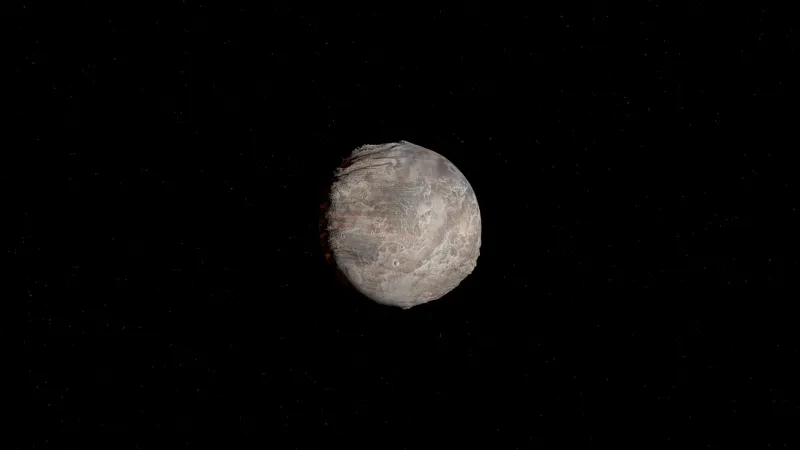
For decades, Pluto existed mostly as a dot. A faint, blurry smudge in even the most powerful Earth-based telescopes, it was easy to dismiss — a tiny, frozen relic tumbling around the outer edge of the solar system, doing nothing particularly interesting. When the International Astronomical Union voted in 2006 to strip Pluto of its planetary status, plenty of scientists shrugged. It seemed about right for something so small and so distant.
Then New Horizons showed up, and Pluto had some things to say.
On July 14, 2015, after traveling more than three billion miles over the course of nine years, NASA's New Horizons spacecraft made its closest approach to Pluto — screaming past at roughly 31,000 miles per hour. The images and data it sent back rewrote nearly everything we thought we knew about this distant world. And for a lot of people in the planetary science community, it also quietly reopened the debate about whether we'd been too hasty with that 2006 vote.
A Heart That Stole the World's Attention
If you were online in the summer of 2015, you probably remember the image. A heart-shaped region of bright, pale terrain sprawling across Pluto's surface — unofficially named Tombaugh Regio, in honor of Clyde Tombaugh, the astronomer who discovered Pluto in 1930. It became an instant icon, the kind of science image that transcends the usual audience of researchers and space nerds and lands on t-shirts, phone cases, and late-night TV monologues.
But beyond the aesthetics, that bright region was scientifically extraordinary. The western lobe of the heart — now called Sputnik Planitia — turned out to be a vast plain of nitrogen ice, roughly the size of Texas and Oklahoma combined. And it wasn't just sitting there, inert. Scientists discovered that the ice in this basin is slowly churning, driven by heat from Pluto's interior in a process called convection. Imagine a lava lamp, but made of nitrogen ice and roughly a thousand miles wide.
This was not the dead, frozen wasteland anyone had anticipated.
Mountains Made of Water Ice — Yes, Really
Just as surprising as the nitrogen plains were the mountain ranges that border them. New Horizons captured images of peaks rising as high as 11,000 feet — comparable to parts of the Rocky Mountains here in the US. On Pluto. A world with no known tectonic activity, no large moon tugging at it with significant tidal forces, no obvious energy source to build mountains like that.
Here's the kicker: those mountains are made of water ice. Not rock. Not silicate material. Frozen water, which on Pluto is hard enough to behave like rock because the temperatures there hover around -380 degrees Fahrenheit. The existence of these formations suggested that Pluto had experienced — and may still be experiencing — significant geological activity. Something is generating internal heat. Scientists aren't entirely sure what, and that uncertainty is a big part of what makes this so exciting.
The Subsurface Ocean Question
Things got even more interesting when researchers started analyzing the data more carefully. The way Sputnik Planitia sits in Pluto's landscape — always facing toward its largest moon, Charon — suggests a phenomenon called tidal locking. But for that alignment to work out the way it does, there may need to be a liquid layer beneath Pluto's surface. A subsurface ocean.
Let that sink in for a second. Pluto — the world we demoted, the one we basically called too small and too far away to matter — might have a liquid water ocean hiding beneath its icy shell.
Now, scientists are careful to say this is still a hypothesis, not a confirmed fact. But the evidence is compelling enough that it's being taken seriously. And it puts Pluto in interesting company: Europa, Enceladus, and Ganymede are all moons believed to harbor subsurface oceans, and they've become some of the most exciting targets in the search for extraterrestrial life. If Pluto belongs in that conversation, the implications are significant.
A Hazy, Complex Atmosphere
Pluto also turned out to have a far more layered and structured atmosphere than anyone expected. New Horizons detected multiple distinct haze layers extending hundreds of miles above the surface, tinted blue by the scattering of sunlight — the same basic physics that makes Earth's sky blue. The atmosphere is primarily nitrogen, with traces of methane and carbon monoxide, and it interacts with solar radiation to create complex organic molecules called tholins that give Pluto's surface its reddish-brown coloring in places.
For a world that was supposed to be a simple, inert iceball, Pluto was putting on quite a show.
So... Should We Have Demoted It?
This is where things get genuinely complicated, and it's a question this site has a vested interest in asking. The IAU's 2006 definition requires a planet to do three things: orbit the sun, have enough mass to be roughly spherical, and — this is the sticking point — "clear the neighborhood" around its orbit. Pluto fails that third test because it shares its orbital neighborhood with countless other Kuiper Belt objects.
But the New Horizons data has given fresh ammunition to scientists who argue that geological complexity, not orbital dynamics, should be the defining characteristic of a planet. Alan Stern, the principal investigator for New Horizons, has been one of the most vocal critics of the 2006 definition. He and others have proposed geophysical definitions that would focus on whether a body is massive enough to be rounded by its own gravity — a definition that would reinstate Pluto and also add dozens of other bodies to the planetary roster.
The debate hasn't been resolved. The IAU definition still stands, and Pluto is still officially a dwarf planet. But the conversation is livelier than it's ever been, and New Horizons is the reason why.
What Comes Next
New Horizons didn't stop at Pluto. In January 2019, it flew past Arrokoth, a small Kuiper Belt object about four billion miles from the sun, giving us our first close look at one of the primordial building blocks of the solar system. The spacecraft is still out there, now more than five billion miles from Earth, continuing to send back data about the environment at the edge of our solar system.
But Pluto remains its defining achievement. A mission that began as a long shot — funding was nearly canceled multiple times before launch — ended up delivering one of the most transformative datasets in the history of planetary science. It turned a blurry dot into a living, breathing, geologically active world that refuses to be ignored.
Wherever you land on the planet-vs-dwarf-planet debate, one thing is hard to argue with: Pluto earned a second look. And what we saw when we finally got close enough to look was something nobody fully expected.
Maybe that's the real lesson here. The solar system keeps surprising us when we bother to show up and pay attention.